The sandbox optimization problem (and what comes after)
 Jeffrey Lin3 min read
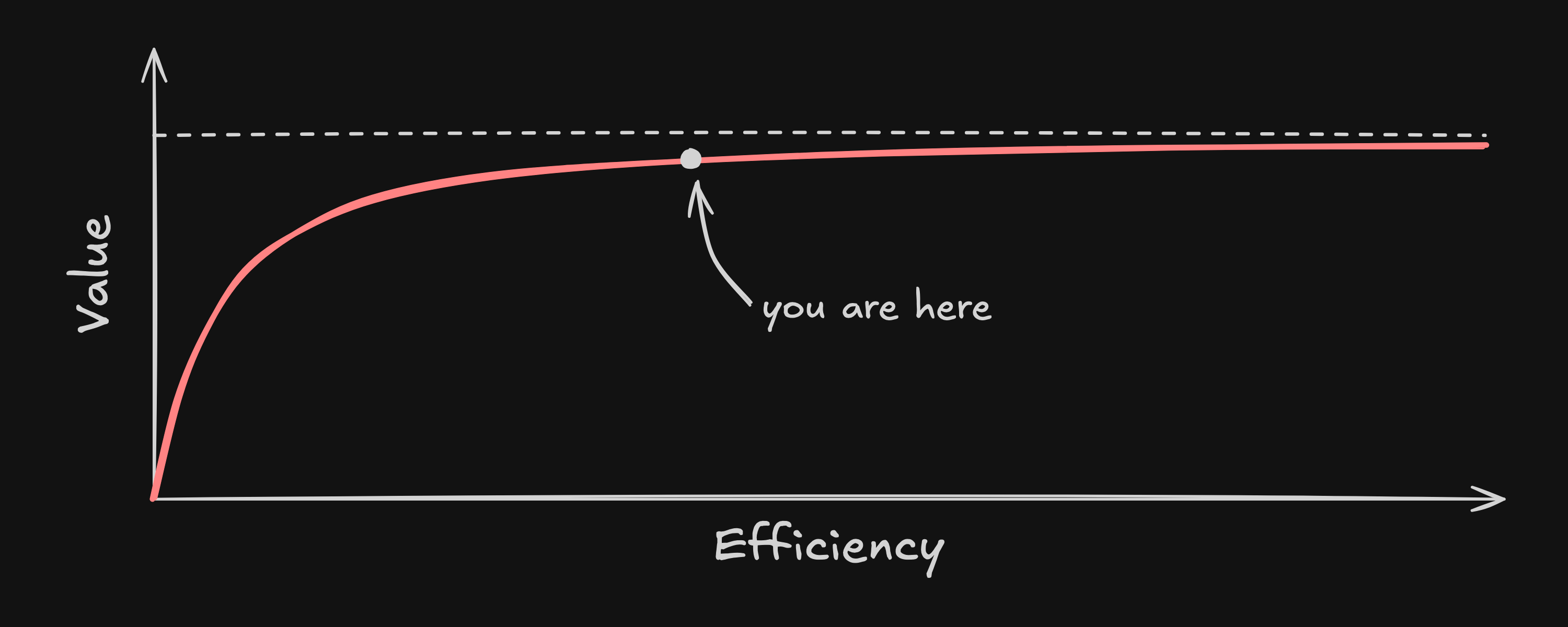
If you’ve been on X recently, you’ve probably seen the beef between sandbox providers. The “sandbox war” is basically a race to zero on two main metrics: startup time and price.
While the competition is producing genuinely better infrastructure, these metrics have an asymptote. Marginal improvements in strength don’t really make the product much better when isolation is strong enough for a task.
Basically, the sandbox market is largely an optimization problem with a frontier. Companies will obviously build better businesses than others but you can only push the numbers so far.
The products that are built around these metrics however, have no equivalent constraint ;)
The race to the bottom
Consider a competitive general sandbox provider.
At scale, there is a large incentive to get closer to the hardware. It might start to make sense to rent or own bare metal servers instead of paying a margin to cloud providers. Then, you provision these servers with something like Firecracker VMs. You layer on scheduling and orchestration to keep utilization as high as possible. Then you start keeping things warm, build snapshots, etc.
There’s not many places for cost and latency to reduce on:
- Hardware: get cheaper compute or own more of the stack
- Density: fit more work onto the hardware
- Utilization: increase the amount of working capacity
- Overhead: reduce virtualization and orchestration cost
- Warmth: preboot, snapshot, cache, etc.
- Margin: charge less
The direction for optimization is pretty clear and signs of convergence are already showing. E2B and Daytona currently both charge the same base rates for CPU and memory: $0.0504 per vCPU-hour and $0.0162 per GiB-hour. This obviously isn’t the floor but it’s an interesting early signal.
The “frontier” isn’t just a single architecture though. You can trade memory for faster startup or accept higher costs for specialized hardware.
Instead, the frontier is the set of tradeoffs that can’t be improved without making something else worse. Startup latency will approach zero, and pricing will approach the underlying cost of the compute.
Everyone will get closer to the technical frontier as several companies attack the same problem. The architectures won’t be the same and providers will specialize but a 10x advantage on basic metrics will be harder to sustain as the market matures.
What happens when the infrastructure is good enough?
A sandbox is a pretty generic primitive: spin up an isolated computer, do something on it, then kill it. This idea can sit under products that have almost no similarities.
CI needs isolated machines to run jobs, security products need to run untrusted code, and coding agents will need to call a million random tools.
At some level they’re all solving the same infra problem, but not one of these products is selling the underlying sandboxing.
I’m not saying these companies will all run on the biggest sandbox providers. A company could start building the product on their own infra from day one in order to optimize specifically for their use case. A more mature company could begin to own the stack themselves.
As the underlying primitive converges to that same frontier, the design space above it becomes larger. Devboxes optimize around developer experience while agents optimize around autonomous work.
The products built around the primitive do not have a relatively known optimization function like sandboxes do. It’s hard to say what agents will look like when giving each task a computer is trivial or what dev envs will look like when compute is effectively disposable.
So who wins the “sandbox war”?
Well, there probably won’t be one winner. Obviously, there are many different ways sandbox providers can differentiate through scale, distribution, hardware, and much more even as the economics converge. They’re just competing on dimensions that have known limits.
When the time comes that isolated sandboxes become fast, cheap and easy enough to provision, it’ll become reasonable to design products around the assumption that you can spin up a computer somewhere whenever you need one.
In some ways, the state of sandboxes is kind of like EC2. I don’t think a single provider will distribute sandboxes as a primitive like AWS did, but EC2 put compute behind an api and most of the value created by products around it wasn’t just to spin servers up. EC2 enabled a bunch of new categories of software.
We’re spending a lot of time comparing milliseconds and cents on linux VMs, but what comes after? What will software look like when disposable compute becomes a primitive to be taken for granted?
p.s. check out tesser.sh if you want specialized VMs for development environments.... 😅